
At its core, programmatic advertising is simply a smarter, automated way to buy and sell digital ad space. Forget the old-school method of lengthy negotiations and manual paperwork. Think of it instead as a lightning-fast, real-time auction for online ads.
An Introduction to Automated Ad Buying
Not long ago, buying digital advertising was a grind. It meant back-and-forth phone calls, drawn-out price haggling, and stacks of insertion orders between advertisers and publishers. The whole system was clunky, slow, and often felt like a shot in the dark when it came to reaching the right audience.
Programmatic advertising turned that model on its head. By bringing automation into the mix, it created a sophisticated ecosystem where ad impressions are bought and sold in real-time. Instead of buying a fixed block of space on one website, you can now bid on individual ad impressions for specific users across thousands of sites—all in the blink of an eye.
A High-Speed Digital Auction in Action
Let’s put this into perspective. Imagine someone who perfectly matches your ideal customer profile lands on a blog. In the milliseconds it takes for that webpage to load, a behind-the-scenes auction kicks off.
Your ad—along with ads from your competitors—bids for the chance to appear in front of that specific person. The highest bidder wins, and their ad is instantly displayed. This entire process is automated, ensuring your budget is laser-focused on reaching only the most relevant people.
This seamless transaction relies on several key platforms working together. To help clarify how these pieces fit together, here's a quick breakdown of the major players.
The Programmatic Advertising Ecosystem at a Glance
This table breaks down the essential platforms and players, clarifying their unique roles in the automated ad buying process.
| Component | Primary Role | Who Uses It? |
|---|---|---|
| Demand-Side Platform (DSP) | A platform that allows advertisers and agencies to buy ad inventory from various sources and manage their campaigns. | Advertisers and Marketing Agencies |
| Supply-Side Platform (SSP) | A platform that enables web publishers to manage and sell their ad inventory to advertisers. | Publishers and Website Owners |
| Ad Exchange | An online marketplace that facilitates the real-time buying and selling of ad inventory between DSPs and SSPs. | Both Advertisers and Publishers |
Each component has a distinct job, but they all collaborate to make the auction happen smoothly and efficiently.
This powerful technology is often a cornerstone of a comprehensive marketing automation strategy. It’s a perfect example of how automation enables smarter, more results-driven marketing.
By taking routine tasks like bidding and ad placement off your team's plate, programmatic technology frees them up to focus on what humans do best: crafting brilliant strategy and compelling creative. It’s a shift from manual grunt work to strategic oversight.
How a Programmatic Ad Buy Actually Works
So, what really happens in that split second between you visiting a website and an advert loading on the screen? It's a lightning-fast process, much like a high-speed stock exchange, where multiple pieces of technology work together in perfect harmony.
At its core, the transaction is quite simple. Advertisers want to reach specific types of people, and publishers have the ad space (what we call inventory) on their websites to make that happen. Programmatic advertising is simply the automated bridge connecting this supply and demand.
Let's pull back the curtain and look at the mechanics behind a single ad impression.
The Key Players in the Auction
To make any programmatic ad buy happen, you need three main players. Each has a distinct job to do, ensuring the right advert wins the auction and is shown to the right person.
-
Demand-Side Platform (DSP): This is the advertiser's control panel. A DSP is the software businesses and agencies use to manage their campaigns. It’s where they define who they want to reach (based on things like location, interests, and browsing behaviour) and how much they’re willing to bid for ad space.
-
Supply-Side Platform (SSP): This is the publisher's tool. Website owners use an SSP to manage all their available ad slots and connect them to a vast pool of potential advertisers. The goal is to get the best possible price for their inventory.
-
Ad Exchange: Think of this as the digital marketplace where the DSPs and SSPs meet to do business. The ad exchange is the auction house that facilitates the buying and selling of ad impressions in real time.
These three platforms talk to each other in milliseconds, creating a dynamic, competitive market for every single ad that gets displayed. This whole sequence is driven by a process known as Real-Time Bidding.
Demystifying Real-Time Bidding (RTB)
Real-Time Bidding (RTB) is the engine that powers programmatic advertising. It’s the auction model that determines which ad gets shown, where it appears, and for what price. The entire process is incredibly fast, often completed in less than 100 milliseconds – literally quicker than the blink of an eye.
Here’s a simplified look at how data flows through the system to serve a single advert.
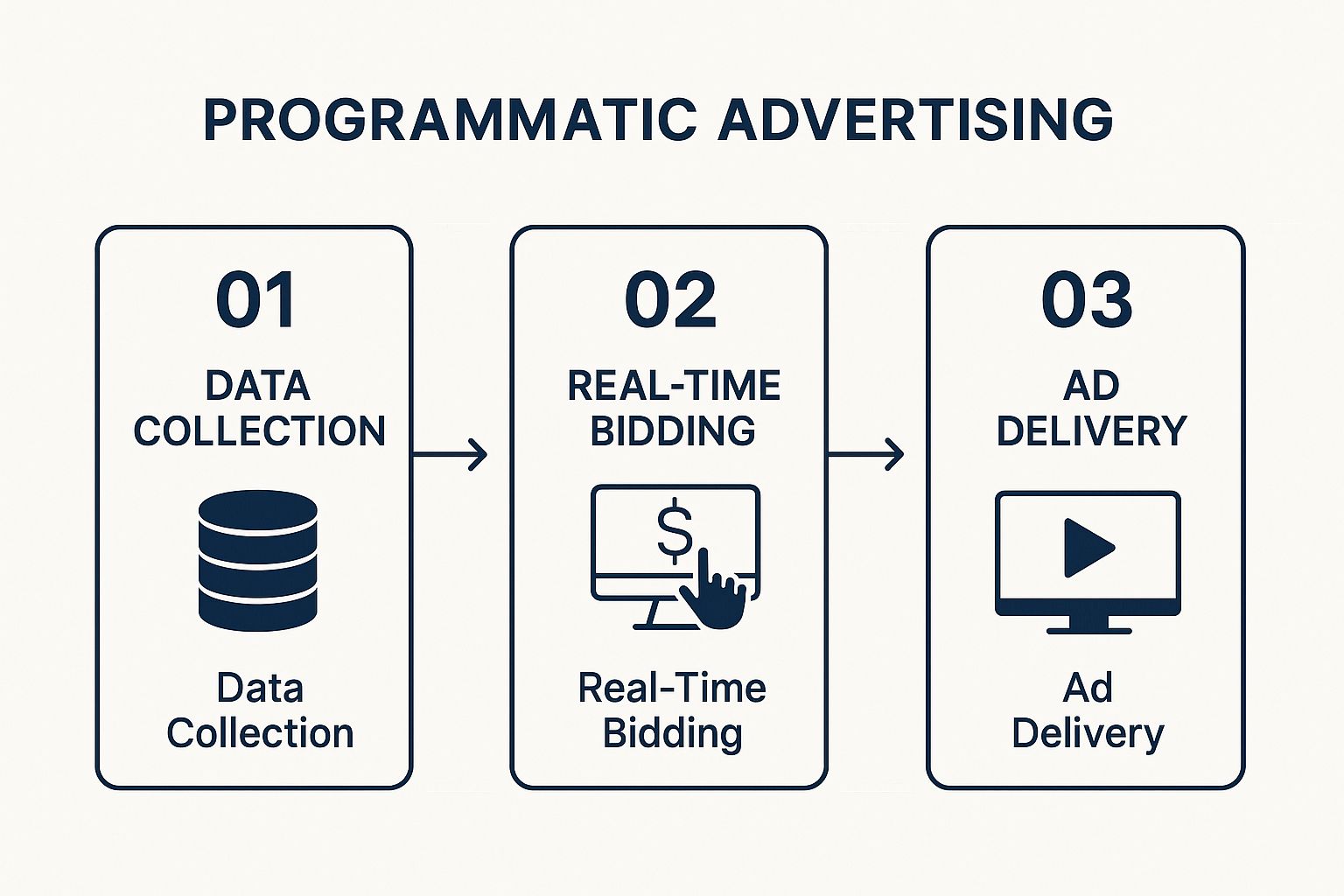
As you can see, the moment a user lands on a page, a request goes out, an auction takes place, and the winning advertiser’s creative is delivered almost instantly. It’s all automated for maximum efficiency.
The real magic of programmatic isn't just the speed; it's the intelligence. You're not just buying ad space on a particular website. You're buying a chance to speak to a specific audience member at the perfect moment, no matter where they are online.
This approach shifts advertising from a broad, hope-for-the-best activity into a precise, data-backed operation. Once you understand how the programmatic buy works, it’s easy to see why it’s so much more efficient and targeted than old-school methods.
Choosing the Right Programmatic Deal Type

When people talk about programmatic advertising, they usually picture the whirlwind of an open auction. But that's just one piece of the puzzle. Experienced advertisers know that different campaign goals call for different tactics, and that means choosing the right deal type to balance reach, cost, and exclusivity.
Think of it this way: picking the right deal is less about finding the single "best" option and more about matching the tool to the job at hand. Are you trying to build mass brand awareness, or do you need to secure a premium spot for a major product launch? Your answer to that question is just as critical as the bidding strategy you employ.
The Open Auction: Maximum Reach with Real-Time Bidding
This is the classic programmatic model and the one most people are familiar with. The open auction, often just called Real-Time Bidding (RTB), is essentially a massive public marketplace. Ad space is sold to the highest bidder in real-time, one impression at a time.
- Best for: Casting a wide net. It’s perfect for brand awareness campaigns where the goal is to get your name in front of as many people as possible. New businesses or those launching in a new market often start here to generate buzz at a competitive price.
- Key Feature: The scale is immense, giving you access to countless websites and apps. The trade-off? You have less direct control over exactly where your ads appear, offering the least publisher transparency.
This model is the engine of programmatic, but its power is only truly unlocked with the right bidding strategy. If you're weighing your options, getting to grips with automated versus manual bidding is a great next step. We break it all down in our guide to smart bidding vs. manual bidding.
Private and Preferred Deals: More Control and Exclusivity
For advertisers who need a bit more finesse, private deals offer a more controlled environment. These are essentially invitation-only auctions or fixed-price agreements that let you get first dibs on a publisher's best inventory before it ever reaches the open market.
Private Marketplace (PMP): This is an invite-only auction where a publisher offers their inventory to a handpicked group of advertisers. A luxury car brand, for instance, could use a PMP to ensure its ads are only shown on premium automotive blogs and news sites.
Preferred Deals: This takes exclusivity a step further. An advertiser agrees on a fixed price with a publisher for their inventory. This gives the advertiser the "first right of refusal" on premium ad spots before they're offered to anyone else, even in a PMP.
Programmatic Guaranteed: This is the programmatic equivalent of a traditional media buy. Here, an advertiser commits to purchasing a set volume of impressions from a specific publisher at a fixed price. It guarantees delivery, making it the ideal choice for major campaigns where securing that high-value inventory is non-negotiable.
The growing popularity of these more sophisticated deals signals real confidence in the market. In fact, the UK programmatic advertising market is set to grow by a staggering 26.97% each year between 2025 and 2035. This boom is being supercharged by AI, with forecasts showing that up to 80% of UK digital display ads will use AI for sharper targeting by 2025. You can read more about the future of programmatic in the UK and what it means for advertisers.
The Real-World Wins from Programmatic Advertising
Knowing how programmatic advertising works is a great start, but what really counts is the impact it can have on your business. When you look past the theory, the practical advantages of this automated approach deliver measurable results that can completely reshape your marketing performance and ROI. The main benefits boil down to three things: incredible efficiency, pin-point accuracy, and real-time control.
The first thing you’ll notice is a huge boost in efficiency. The old way of buying ads was a slow, manual slog of phone calls, negotiations, and spreadsheets. Programmatic advertising automates all of that in the blink of an eye. This frees up your team from tedious admin, letting them focus on what they do best: strategy and creative thinking.
This automation also makes your budget go further. By bidding on ad spaces in real time, you're only paying the true market price for each impression. This helps you avoid the hefty mark-ups that often come with buying ad space directly.
Target Your Ideal Customers with Unmatched Precision
The real magic of programmatic is its powerful targeting. Instead of just buying space on a website and crossing your fingers, you can aim your ads at specific individuals using a huge range of data.
This laser-focused approach means you can connect with customers based on:
- Demographics: Find users by age, gender, location, income, and more.
- Interests and Behaviours: Reach people who are passionate about certain topics or frequently visit specific types of websites.
- Purchase Intent: Target users who are actively researching products or services just like yours.
- Remarketing: Reconnect with people who have already visited your website but haven't yet made a purchase.
Imagine a local Birmingham e-commerce shop. They could show their ads directly to fashion lovers within a 20-mile radius who have recently been searching for designer shoes. This level of precision helps smaller businesses punch well above their weight, ensuring every penny of their budget goes towards reaching the right people.
Get Live Feedback and Optimise on the Fly
Programmatic platforms provide a constant stream of performance data. This allows for real-time campaign optimisation, a major step up from waiting weeks for a report to land on your desk. If an ad isn't performing or a certain audience isn't responding, you can make changes instantly to shift your budget and improve results.
Programmatic advertising isn’t a "set it and forget it" tool. It’s a dynamic system that provides the live data needed to continuously refine your campaigns for maximum impact and minimal wasted spend.
This constant feedback loop is brilliant for testing. You can run two versions of an ad at the same time and see which one gets more clicks and drives more sales. To dive deeper into this, check out our guide on why you should be A/B testing your ad copy. This data-first approach takes the guesswork out of advertising and builds a smarter, more effective strategy over time.
This technology is now central to UK advertising. In 2023, programmatic ad spending in the UK hit around $41.74 billion USD, making it the third-largest market in the world. This is fuelled by how much time we spend online—UK adults are now online for over five and a half hours every day, creating huge opportunities for advertisers to connect. You can find more statistics on the UK's dominant digital market on WeAreSocial.com.
What's Next? Key Trends Shaping the Future of Programmatic

The world of programmatic buying never stands still. It's constantly evolving, pushed forward by new technology and shifts in how people consume content. To stay competitive, you have to keep an eye on what's coming next, because the strategies that deliver results today will need to be sharper tomorrow.
One of the biggest shifts we're seeing is programmatic advertising breaking out of its traditional home on websites. Savvy advertisers are now using automated, data-led buying on new frontiers, bringing that laser-focused targeting to screens that were once only available through broad, old-school media buys.
The Rise of CTV and DOOH
Programmatic is no longer confined to a web browser; it’s now appearing on much bigger screens. Two of the most exciting areas leading this expansion are Connected TV (CTV) and Digital-Out-of-Home (DOOH).
-
Connected TV (CTV): This is all about the content people stream on smart TVs and devices like an Apple TV or Amazon Fire Stick. Programmatic CTV lets you place targeted video ads directly into the living rooms of specific households while they watch their favourite shows. It’s the perfect blend of TV's high-impact storytelling and digital’s precision.
-
Digital-Out-of-Home (DOOH): Think of those giant digital billboards in city centres or the screens you see in shopping malls and airports. With programmatic DOOH, you can buy that ad space in real-time, using data like location, weather, or time of day to display incredibly relevant ads to people as they go about their day.
This growth is completely changing the game. For example, the UK's programmatic ad spend is expected to reach a massive $23.19 billion by 2025, with CTV becoming a key channel for brands fighting for audience attention. You can dive deeper into the UK's programmatic growth on eMarketer.com.
The real win here is consistency. A brand can now run a single, unified campaign that follows a customer from their phone to their laptop, onto their living room TV, and even on a public screen during their commute.
Preparing for a Cookieless Future
Another seismic change on the horizon is the end of third-party cookies. For years, these tiny data files have been the foundation of audience targeting online. But with growing privacy concerns, they're being phased out, forcing the entire industry to adapt.
The new focus? First-party data—that is, the information you collect directly from your own customers and website visitors. Building strong customer relationships and your own data assets has never been more valuable.
Alongside this, technologies like AI and machine learning are stepping up. They help advertisers make much smarter predictions and spot audience patterns without ever needing to rely on old-school tracking methods. Navigating this new reality requires careful planning, particularly when you think about your marketing budgets and how much you should invest in the right data strategies. These trends aren't just talk; they are actively reshaping what a successful campaign looks like right now.
Putting Programmatic Advertising to Work for You
Understanding the theory of programmatic advertising is a great start, but turning that knowledge into actual business growth? That’s a whole different ball game. It’s where strategy has to meet execution, and success depends on far more than just having the right technology. You need genuine human expertise to navigate the complexities of the ecosystem and drive real returns.
This is exactly where we come in. At Pure Marketing, we bridge that gap. Our hands-on approach combines powerful platforms with the strategic guidance needed to turn your advertising budget into measurable results. We focus on building campaigns that are laser-focused on your specific goals, whether you’re trying to build brand awareness from scratch or drive direct sales.
A Partnership Focused on Results
Our entire process is built on collaboration and transparency. We’re with our clients every step of the way, making sure the strategy is crystal clear, the execution is seamless, and the performance is always being fine-tuned. It all begins with getting to know your business inside and out.
- Audience Segmentation: First, we work with you to pinpoint and define your ideal customers with incredible precision. This ensures your message lands in front of the people who are most likely to convert.
- Campaign Setup and Launch: Our team takes care of all the technical heavy lifting. From selecting the best platforms and deal types to creating ad copy and visuals that stop the scroll, we handle it all.
- Continuous Optimisation: A campaign is never a 'set it and forget it' affair. We are constantly digging into the performance data, making real-time tweaks to improve efficiency and maximise your return on investment.
The real value of a great programmatic partner isn’t just in managing bids and budgets. It's in providing the strategic insight that turns raw data into profitable business decisions. We’re committed to making the complex simple and delivering results you can actually see.
Integrating for Greater Impact
Programmatic advertising truly shines when it’s working in concert with your other marketing activities. As you think about bringing it on board, it’s worth considering how it fits into your wider strategy, like setting up broader marketing automation for your e-commerce brand. This kind of integrated approach creates a smooth and consistent journey for your customers, no matter where they interact with you.
Ultimately, our goal is to become a natural extension of your own team. We provide fully transparent performance reporting through live dashboards, so you’re never in the dark about how your campaigns are doing. Let us be the partner you need to unlock the true ROI of programmatic advertising.
Common Questions About Programmatic Advertising
Even when you've got the basics down, it’s completely normal for a few questions to pop up about how programmatic advertising really works in practice. Let's tackle some of the most common ones I hear from clients to clear up any lingering doubts.
Is Programmatic Advertising Only for Large Companies?
Not in the slightest. While big corporations certainly use it to achieve massive scale, programmatic is actually a fantastic tool for small and medium-sized businesses. Why? Because its precision targeting and flexible budget controls level the playing field.
It allows smaller brands to compete by zeroing in on niche audiences with incredible efficiency. This makes your ad spend work much harder, ensuring you’re only paying to reach the most relevant potential customers, even without a massive budget.
Think of it this way: a local artisanal bakery can now target food lovers within a specific postcode, an opportunity that was once only available to national chains with deep pockets. That kind of precision makes every pound count.
Programmatic advertising isn’t just about scale; it’s about access. It gives any business, regardless of size, a direct line to its ideal audience, effectively democratising sophisticated advertising tools.
How Does Programmatic Advertising Ensure Brand Safety?
Brand safety is, quite rightly, a huge concern for any advertiser. No one wants their ads appearing next to unsuitable or damaging content. Thankfully, programmatic platforms have robust measures built-in to prevent this. You actually get a great deal of control over where your ads appear.
Here are the key tools we use to protect our clients' brand reputations:
- Whitelists: These are your hand-picked lists of pre-approved, high-quality websites where you want your ads to run.
- Blacklists: This is the opposite—a list of specific sites, apps, or content categories you want to explicitly avoid at all costs.
- Third-Party Verification: We can also use independent services that scan web pages in real-time. They analyse the content on the fly and block your ad from appearing if the environment is deemed unsafe.
What Is the Main Difference Between Programmatic and Google Ads?
This is probably the most frequent point of confusion, and it’s a great question. The easiest way to think about it is that Google Ads is a powerful, but mostly self-contained, ecosystem. It operates primarily within Google's own universe—think Google Search, YouTube, and its display partner network.
Programmatic advertising, on the other hand, is your key to the entire open internet. It gives you access to a much wider inventory across thousands of different publishers, apps, and ad exchanges that exist outside of Google's direct control.
So, while Google Ads is a vital channel in any digital strategy, programmatic is what unlocks almost everything else.
Ready to see how a data-driven programmatic strategy can deliver real results for your business? The in-house experts at Pure Marketing create bespoke campaigns that connect you with your ideal customers and drive measurable growth.